How to Justify Hog Trap Costs: A 2026 Guide
Table of Contents
- Why Feral Hog Damage Costs Make Trap Investment Urgent
- Hog Trap Cost Components: Upfront, Installation, and Maintenance
- Calculating Hog Trap Return on Investment
- Cost to Hire a Hog Trapper vs. Buying Your Own Trap
- Hog Trap Maintenance Costs and Operating Budget
- How to Justify Hog Trap Costs to a Landowner or Manager
- Frequently Asked Questions
Last Updated: October 9, 2026
Why Feral Hog Damage Costs Make Trap Investment Urgent
Feral hogs are one of the most destructive invasive species in the United States, and the financial damage they cause to agricultural operations is substantial. A 2026 survey from the USDA National Wildlife Research Center found that feral hog damage costs U.S. agriculture an estimated $2.5 billion annually.
To justify hog trap costs, first quantify what you’re already losing. You’re not spending money on a trap, you’re stopping a bleed.
Feral hog damage shows up as crop and pasture losses and long-term land damage, both compound over time.
Crop and Pasture Losses by Acreage
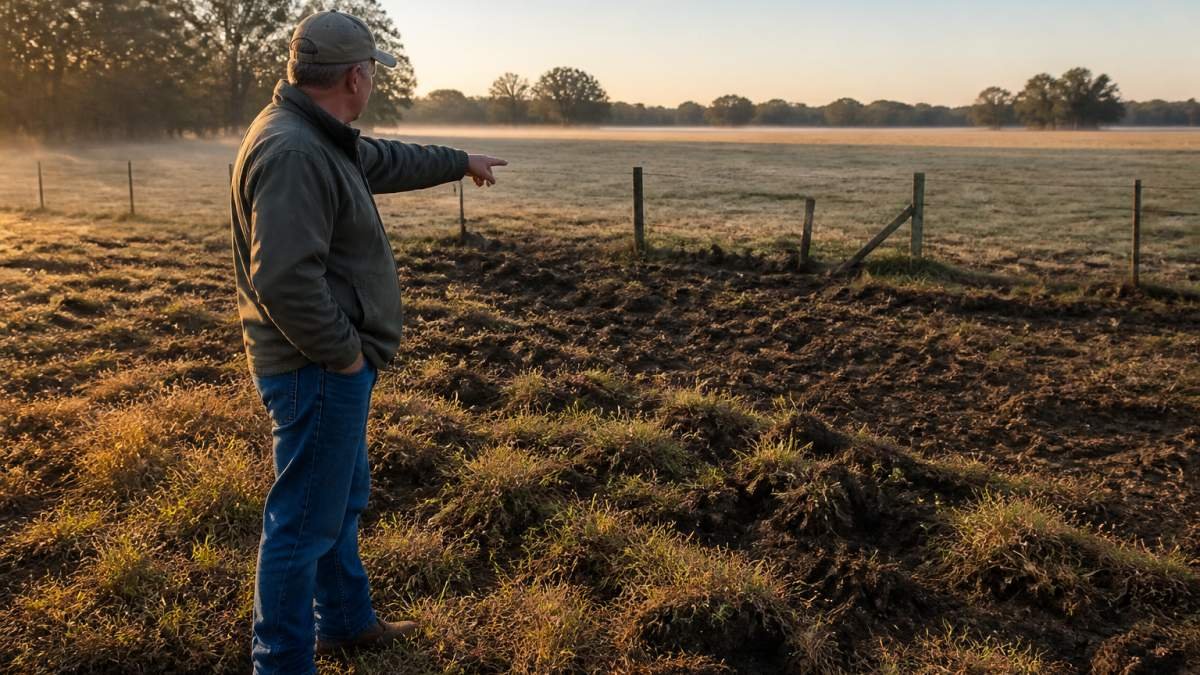
A single sounder can root through several acres of pasture in one night. Row crops like corn, sorghum, and peanuts are especially vulnerable during planting and harvest.
On small acreage, modest hog activity can wipe out a season’s margin; on large ranches, damage spreads across hundreds of acres as a recurring annual expense.
Infrastructure and Long-Term Land Damage
Hogs also tear up fences, rut roads, damage stock tanks, and destabilize creek banks. Repair costs add up fast, and some damage, eroded topsoil, compacted rooting zones, takes years to recover.
That long-term damage is where the real cost hides. A trap costing a few hundred dollars upfront looks expensive until you compare it to five years of fence repair and lost grazing capacity.
Hog Trap Cost Components: Upfront, Installation, and Maintenance
Hog trap costs break down into three categories: the trap itself, installation and setup, and ongoing maintenance. Understanding each helps you compare options fairly.
DIY vs. Commercial Trap Cost Comparison
DIY traps are cheaper upfront but carry hidden costs: materials sourcing, assembly time, and shorter lifespan. Commercial traps cost more initially but last longer and need less repair.
| Factor | DIY Trap | Commercial Trap |
|---|---|---|
| Upfront cost | Lower | Higher |
| Assembly time | Significant | Minimal |
| Lifespan | Shorter | Longer |
| Repair frequency | Higher | Lower |
| Sounder capture rate | Variable | Consistent |
For most landowners managing ongoing hog pressure, commercial traps deliver better long-term value, especially once you factor in labor.
The cheapest trap is rarely the most cost-effective one. A trap that fails after two seasons costs you the trap, the hogs you didn’t catch, and the damage they did while you were repairing it.
Corral, Box, and Drop-Net Traps: Capacity and Cost per Hog
Corral traps catch entire sounders at once, making them the most efficient option for population control. Box traps catch one or two hogs at a time.
Cost per hog removed is the metric that matters. A corral trap catching eight hogs in one event beats a box trap catching one per week, even at a higher upfront cost.
Calculating Hog Trap Return on Investment
Hog trap return on investment is the total value of damage prevented divided by the total cost of the trap and its operation. The formula is simple, but the inputs require honest accounting, most landowners leave out the line items that decide whether the math works.
A Step-by-Step ROI Formula for Your Operation
Use this framework to calculate ROI:
- Estimate annual damage costs (crop loss, pasture loss, infrastructure repair)
- Estimate the percentage of that damage a trap system can prevent
- Add total trap cost: purchase, installation, and annual maintenance
- Divide prevented damage by total cost
If your operation loses $8,000 per year to hogs and a trap system prevents 75% of that damage, you’re saving $6,000 annually. Against a $2,000 total first-year cost, that’s a clear return.
Total Cost of Ownership: The Line Items Most People Forget
Headline trap prices hide the real cost. Build a total-cost-of-ownership (TCO) estimate before comparing a $400 DIY build to a $2,500 commercial corral trap.
| Cost category | What to include | Typical pattern |
|---|---|---|
| Trap purchase or build | Trap, gate, trigger, panels, hardware | One-time |
| Site prep and installation | Posts, anchors, leveling, access trail | One-time |
| Bait | Corn, sour mash, commercial attractants | Recurring, weekly during active trapping |
| Cameras and monitoring | Cellular or SD trail cameras, batteries, data plan | Recurring |
| Labor | Setup, daily checks, dispatch, reset | Recurring, largest hidden cost |
| Transport and disposal | Trailer, fuel, carcass disposal | Per removal event |
| Repairs and replacement | Gate, trigger, panel, cable, net | Recurring |
Labor and bait usually dominate the recurring budget, and neither shows up in a sticker price. A trap that costs $500 less but needs an extra 30 minutes of checking per day for a 90-day window is not the cheaper trap.
Valuing Your Labor Honestly
Most landowners treat their own time as free. It isn’t. A defensible ROI calculation assigns a dollar value to trapping labor, even if that’s just your opportunity cost.
A common pattern is to estimate:
- Setup hours, one-time, typically a half day to a full day per trap site
- Check hours, daily or every other day during active trapping
- Dispatch and reset hours, per removal event
Multiply total hours by a reasonable rate (your own or a hired-hand rate). Add that to the trap cost before you divide. Skipping this step is the most common reason a trap looks cheaper on paper than in practice.
Accounting for Failed and Incomplete Trapping
Not every trap night produces a hog. Trap-shy hogs, partial sounder removal, and trigger failures raise your effective cost per hog. A realistic ROI model includes a failure allowance, a percentage of empty trap nights and partially removed sounders.
When a sounder is only partially removed, survivors often become trap-shy, raising the cost of every subsequent removal. That’s a real cost and belongs in the model.
Scenario Comparison: Small Acreage vs. Large Ranch
On 50 acres with moderate pressure, damage might run a few thousand dollars per year.
On 500+ acres with heavy pressure, multiple traps, more monitoring, and higher maintenance come into play, but so does the damage prevented.
Cost per hog removed falls as trap capacity and sounder capture rate rise. A corral trap removing a full sounder in one event usually beats a box trap on cost per hog, even at several times the upfront price.
The bigger your operation and the heavier your hog pressure, the easier it is to justify a commercial trap system. Small operations need to be more selective about which trap they buy, and more disciplined about counting labor, bait, and failed trap nights in the math.
Cost to Hire a Hog Trapper vs. Buying Your Own Trap
The cost to hire a hog trapper varies by region, usually per-hog or per-project. For recurring hog problems, hiring out every season gets expensive fast.
Buying your own trap shifts that recurring cost into a one-time capital expense.
For one-time cleanup on a small property, hiring may make sense. For ongoing control, owning wins on cost over any multi-year horizon.
Hog Trap Maintenance Costs and Operating Budget
Hog trap maintenance costs are often overlooked. Even a well-built trap needs periodic inspection, gate adjustments, and repairs after heavy use.
Budget for:
- Annual inspection and hardware tightening
- Replacement of worn components
- Bait and monitoring time
Galvanized steel resists rust far better than untreated steel, cutting long-term maintenance costs. That’s why we build every Texas Feeder Solutions trap from 100% galvanized steel and back it with a lifetime warranty.
Skipping maintenance checks is the fastest way to lose a sounder. A bent gate or a loose trigger mechanism lets hogs escape and teaches them to avoid the trap entirely.
How to Justify Hog Trap Costs to a Landowner or Manager
Justifying hog trap costs to a landowner, manager, or funding decision-maker comes down to showing the numbers clearly. Emotion and anecdote won’t win the argument, a cost-benefit breakdown will, but it must survive scrutiny with a template, a sample, and an evidence trail.
Building a One-Page Cost Justification
Keep it short and specific. Include:
- Current annual damage estimate
- Total trap cost (purchase, install, first-year maintenance)
- Projected damage prevented
A one-page summary with these five numbers beats a lengthy report. But the numbers are only as good as their assumptions, so attach a short note: how you estimated damage, the prevention percentage you assume, and your labor rate.
A Reusable Budget Template
Use this structure for any property, any trap type. Fill in your own numbers; the categories stay the same.
| Line item | Year 1 | Year 2 | Year 3 |
|---|---|---|---|
| Trap purchase or build | |||
| Site prep and installation | |||
| Bait | |||
| Cameras and monitoring | |||
| Labor (setup, checks, dispatch, reset) | |||
| Transport and disposal | |||
| Repairs and replacement | |||
| Total cost | |||
| Damage avoided (crop, pasture, fence, infrastructure) | |||
| Net benefit | |||
| Cumulative net benefit |
Three years usually shows the trend without overreaching. If cumulative net benefit is positive by Year 2 or 3, the case is strong. If not, the trap type or scale is probably wrong for the property.
A Sample Business Case
Here’s how the template reads when it’s filled in. Numbers are illustrative, substitute your own.
Property: 200 acres, mixed pasture and row crop, moderate to heavy hog pressure.
Current annual damage: $6,000 (crop loss, fence repair, pasture degradation).
Proposed system: One commercial corral trap with cellular camera.
Year 1 total cost: $3,200 (trap, install, bait, camera, labor, disposal).
Assumed damage reduction: 70%.
Damage avoided: $4,200.
Year 1 net benefit: $1,000.
Year 2-3 net benefit: $3,000-$3,500 per year (lower cost, similar damage avoided).
Three-year cumulative net benefit: roughly $7,000-$8,000.
The point isn’t the specific dollars, it’s the shape: a one-time cost, a smaller recurring cost, and a damage-avoided line that stays flat or grows as hog pressure persists.
Evidence Checklist
Decision-makers ask for proof. Have these ready:
- Trail camera photos or video showing hog activity and sounder size
- Damage photos with dates and locations
- Repair receipts or contractor estimates for fence, road, or stock tank damage
Those seven items answer almost every question a landowner or manager will raise.
Handling Uncertainty and Regional Price Variation
Trap prices, labor rates, and damage severity vary by region and year. Don’t pretend otherwise, present a range:
- Low case: conservative damage estimate, conservative prevention percentage
- Base case: your best estimate
- High case: heavier pressure, higher prevention percentage
If the low case still shows positive net benefit over three years, the decision is easy. If only the high case works, say so and explain what would have to be true. Decision-makers trust a range more than a single number, it signals you’ve considered the downside.
Using Cost-Share and Financial Assistance Programs
Several state and federal programs offer cost-share or financial assistance for feral hog control. The USDA Natural Resources Conservation Service administers programs that can offset trap purchases for qualifying landowners.
Check eligibility carefully. Most programs require an approved conservation plan and may prioritize larger acreage or specific habitat types. Cost-share doesn’t change the ROI math, it changes who pays upfront, so run the template with and without the offset.
Bring the template, the sample, and the evidence file to the conversation. A decision-maker who sees a structured budget and a documented damage history is far more likely to approve the spend than one who hears a verbal estimate.
Frequently Asked Questions
How do you calculate the return on investment for a hog trap?
Start by estimating annual damage costs from rooting, crop loss, and infrastructure repair. Add the cost to hire a hog trapper or the value of your own labor. Then total your trap investment: purchase price, installation materials, and annual maintenance. Divide the damage avoided by the total cost. A trap that removes a full sounder and prevents $3,000 in yearly damage pays for itself quickly. Adjust for your acreage and hog population.
What ongoing costs should you include when budgeting for a hog trap?
Include bait, fuel for monitoring, replacement parts like damaged gates or wire, and your time. If you hire someone to check traps, add that labor. Galvanized steel traps reduce repair costs because they resist rust. Budget for at least two inspections per week during active trapping. These hog trap maintenance costs are small compared to hiring a trapper, but they matter for your total cost of ownership.
How can landowners compare buying a hog trap with hiring a trapper?
Hiring a trapper typically costs a per-hog fee plus travel, and you may wait for availability. Buying a trap is a larger upfront cost, but you control the schedule and can trap year after year. For long-term control, a durable trap often costs less per hog removed. Use our ROI method to compare your specific situation. If you have recurring hog pressure, ownership usually wins on cost-effectiveness.
What are the disadvantages of using hog traps?
Traps require regular monitoring, and a poorly designed gate can let part of a sounder escape. Cheap traps may bend or rust, adding repair costs. You also need to check local regulations on trapping and disposal. However, a heavy-duty galvanized steel trap with a reliable trigger addresses most of these issues. The main disadvantage is the upfront cost, which is why justifying the investment with damage data matters.
Feral hog damage doesn’t pause while you weigh your options. Every season without a trap is another season of lost crops, broken fences, and expanding sounders. At Texas Feeder Solutions, we build heavy-duty, 100% galvanized steel trap systems designed to capture entire sounders, backed by a lifetime warranty and a decade of field experience. If you’re ready to stop the damage and start seeing a return, explore our trap systems and find the right fit for your operation.